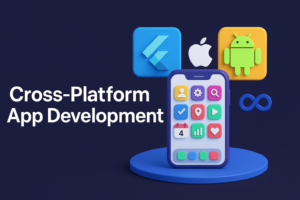
In today’s fast-paced digital landscape, businesses want their apps to reach users on both Android and iOS — without doubling their time, cost, or effort.
That’s where cross-platform app development comes in.
By using frameworks like Flutter, React Native, and Kotlin Multiplatform, companies can build powerful apps from a single codebase while still delivering a near-native experience. But before you choose cross-platform development for your next project, it’s important to understand both its strengths and limitations.
What is Cross-Platform App Development?
Cross-platform app development is the process of creating a single codebase that runs smoothly across multiple operating systems — primarily Android and iOS.
Instead of building and maintaining two separate native apps, developers use one framework that compiles to both platforms.
Popular Cross-Platform Frameworks in 2025:
- Flutter – Google’s UI toolkit known for speed and expressive design.
- React Native – Backed by Meta, widely used for performance-driven apps.
- Kotlin Multiplatform – Allows sharing logic between Android and iOS while keeping native UI layers.
Benefits of Cross-Platform App Development
- Single Codebase, Dual Platforms
Write once, deploy anywhere — significantly reducing development time and effort. - Cost Efficiency
Since only one team and one codebase are required, development and maintenance costs are nearly 40–50% lower than building two native apps. - Faster Time to Market
Launching on both iOS and Android simultaneously means you can reach a wider audience quickly — perfect for startups and MVPs. - Consistent User Experience
Frameworks like Flutter ensure consistent UI and behavior across platforms, offering users a smooth and uniform experience. - Growing Ecosystem & Plugins
Libraries, third-party integrations, and developer communities are expanding rapidly, making cross-platform development more powerful than ever.
Drawbacks of Cross-Platform App Development
- Limited Access to Native Features
Some platform-specific APIs or hardware integrations (e.g., advanced camera, Bluetooth Low Energy, ARKit) may not be fully supported. - Performance Gaps
While frameworks like Flutter minimize this, cross-platform apps may still lag slightly behind fully native apps in heavy GPU/CPU tasks (like gaming or 3D rendering). - UI Inconsistencies on Complex Interfaces
Native UI often feels smoother in apps with highly customized animations or gesture-heavy designs. - Dependency on Framework Updates
Any major update from Apple or Google might cause temporary compatibility issues until the framework catches up.
Best Use Cases for Cross-Platform Development
✅ Startups & MVPs (Minimum Viable Products)
When speed and cost efficiency are top priorities, cross-platform development is ideal.
✅ Business Apps or SaaS Platforms
Internal tools, dashboards, or SaaS mobile clients benefit from shared logic and consistent UI.
✅ E-commerce or Service Apps
Apps like marketplaces or delivery platforms where performance needs are moderate but time-to-market matters.
✅ Content or Social Media Apps
React Native and Flutter are perfect for dynamic feed-based or community apps.
When to Choose Native Instead
❌ High-Performance Gaming or 3D Apps
Native development still wins when performance is critical.
❌ Complex Hardware Integrations
Apps requiring deep camera control, AR/VR features, or low-level system APIs perform better natively.
❌ Platform-Specific UI/UX Goals
If you want an iOS app that feels “Apple-made” or an Android app that feels fully “Material Design,” go native.
🔮 Future of Cross-Platform Development (2025 & Beyond)
Cross-platform frameworks are evolving rapidly.
- Flutter 4.0 introduces better desktop and web support.
- Kotlin Multiplatform allows seamless logic sharing with native flexibility.
- React Native continues improving with Hermes engine and Fabric architecture.
In 2025, businesses no longer have to compromise between performance and efficiency — cross-platform development is becoming a strategic choice rather than a shortcut.
🧭 Final Thoughts
Choosing between cross-platform and native depends on your app’s goals, budget, and scalability needs.
If you need fast deployment, cost savings, and consistent design, cross-platform development is your best bet.
If you need maximum performance or deep hardware control, native development remains unbeatable.